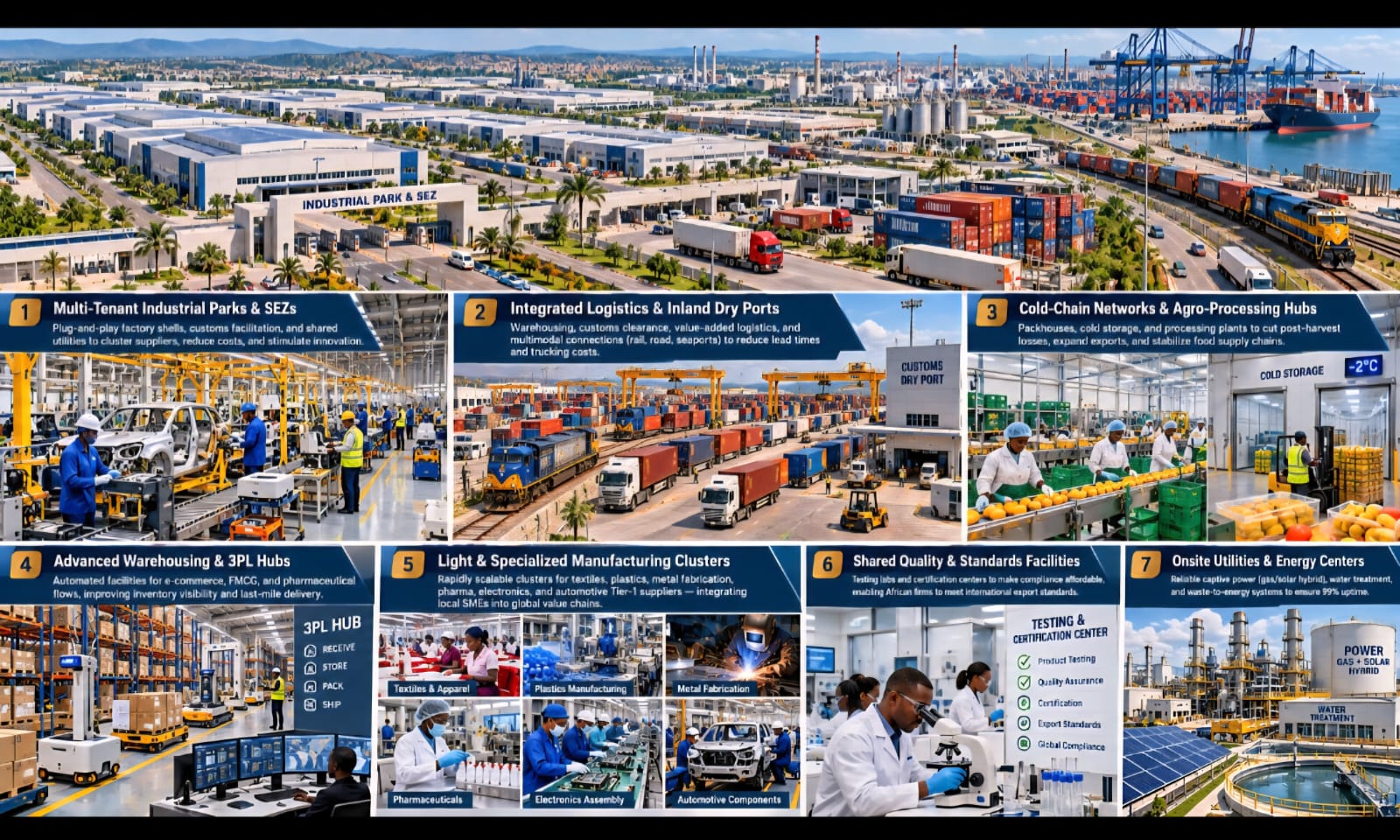
AIIL Manufacturing & Supply-Chain Infrastructure Initiative
African Infrastructure Investment Limited (AIIL) is championing the development of world-class manufacturing and supply-chain ecosystems to catalyze industrialization, create millions of skilled jobs, boost intra-African trade, and diversify African economies beyond raw commodity exports.
This initiative focuses on building industrial parks, logistics hubs, cold-chain networks, and enabling infrastructure that unlock value chains in agro-processing, pharmaceuticals, light manufacturing, heavy industry, and advanced electronics — all aligned with AfCFTA’s vision of a unified African market.
Strategic Objectives
AIIL’s initiative seeks to:
- Localize Value Addition – Process Africa’s raw materials locally before export to increase earnings.
- Reduce Logistics Costs – Build modern transport and distribution corridors for faster market access.
- Generate Jobs & Skills – Develop vocational pathways and formal employment opportunities.
- Boost Export Competitiveness – Prepare African producers for AfCFTA and global markets.
- Enhance Resilience & Sustainability – Guarantee energy, water, and digital reliability through circular, climate-resilient design.
Core Infrastructure Components
- Multi-Tenant Industrial Parks & SEZs
Plug-and-play factory shells, customs facilitation, and shared utilities to cluster suppliers, reduce costs, and stimulate innovation. - Integrated Logistics & Inland Dry Ports
Warehousing, customs clearance, value-added logistics, and multimodal connections (rail, road, seaports) to reduce lead times and trucking costs. - Cold-Chain Networks & Agro-Processing Hubs
Packhouses, cold storage, and processing plants to cut post-harvest losses, expand exports, and stabilize food supply chains. - Advanced Warehousing & 3PL Hubs
Automated facilities for e-commerce, FMCG, and pharmaceutical flows, improving inventory visibility and last-mile delivery. - Light & Specialized Manufacturing Clusters
Rapidly scalable clusters for textiles, plastics, metal fabrication, pharma, electronics, and automotive Tier-1 suppliers — integrating local SMEs into global value chains. - Shared Quality & Standards Facilities
Testing labs and certification centers to make compliance affordable, enabling African firms to meet international export standards. - Onsite Utilities & Energy Centers
Reliable captive power (gas/solar hybrid), water treatment, and waste-to-energy systems to ensure 99% uptime.
Enabling Environment & Policy Alignment
AIIL will work with governments to:
- Simplify customs processes (electronic single windows, preclearance).
- Upgrade ports, rail, and highways to link production zones to export gateways.
- Deploy blended energy solutions (grid + renewables) and resilient water supply systems.
- Co-locate vocational training and R&D centers with industrial parks.
- Build a robust digital backbone for logistics, IoT monitoring, and e-commerce integration.
Financing & Governance Model
AIIL will leverage:
- Public-Private Partnerships (PPP): For SEZs, power, ports, and major logistics infrastructure.
- Blended Finance: Partnering with DFIs and sovereign investors to de-risk early-stage development.
- Anchor Tenant Model: Securing multinational buyers and processors to underwrite park development.
- SME & Cluster Financing: Micro-loans, warehouse receipt financing, and working capital facilities.
Governance will be transparent, with dedicated Corridor/SEZ Authorities, one-stop investor desks, and published performance data to attract confidence and capital.
Implementation Roadmap
Phase 1 (0–6 Months):
- Identify 3–5 priority industrial corridors.
- Launch investor roadshows and SEZ policy framework.
- Establish investor facilitation units.
Phase 2 (6–24 Months):
- Build the first industrial park, logistics hub, and cold-chain pilot.
- Commission vocational training centers.
- Install captive energy and connectivity infrastructure.
Phase 3 (2–5 Years):
- Expand parks and logistics links, onboard anchor tenants, scale SMEs.
- Connect hubs via upgraded rail/road to major ports.
- Grow exports across AfCFTA markets.
Phase 4 (5+ Years):
- Develop specialized manufacturing clusters (electronics, automotive, pharmaceuticals).
- Localize production of selected components and equipment.
Sustainability & Impact
- Economic: Thousands of direct jobs, SME growth, improved trade balance.
- Environmental: Low-carbon design, renewable energy integration, circular economy models.
- Social: Community benefit agreements, skills development, and inclusive growth.
Key KPIs:
Jobs created, MVA growth, logistics lead-time reduction, post-harvest loss reduction, export volume growth, uptime of utilities, number of certified firms.
Call to Action
AIIL invites governments, DFIs, private investors, and global supply-chain leaders to collaborate on this transformative initiative. Together, we can position Nigeria and Africa as competitive manufacturing and trade hubs, building prosperity that is resilient, inclusive, and globally relevant.
Featured Projects
Our featured projects highlight impactful initiatives that drive sustainable development and innovation across the African continent. Each project is designed to strengthen critical infrastructure, promote economic growth, and improve quality of life. Our commitment is to building resilient communities and empowering future generations. Through strategic partnerships, cutting-edge technology, and local capacity building, we are shaping a more inclusive and prosperous Africa.