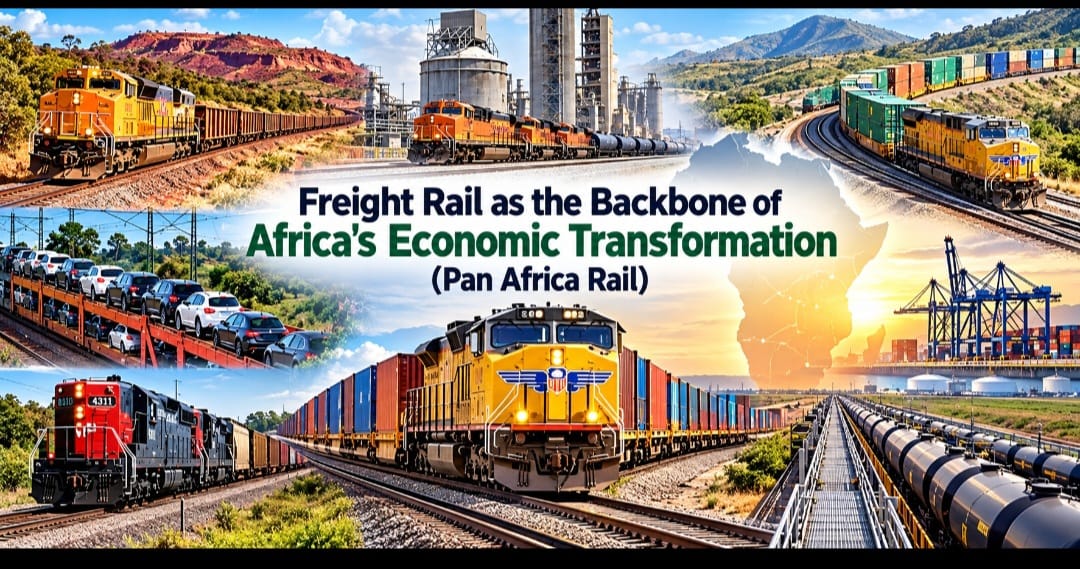
Freight Rail as the Backbone of Africa’s Economic Transformation
Africa’s economic growth, industrialization, and regional integration hinge on efficient logistics. Today, high transport costs remain one of the most significant barriers to competitiveness for African producers. Roads are congested, costly to maintain, and unsustainable for heavy bulk transport.
African Infrastructure Investment Limited (AIIL) recognizes that freight rail is not merely transport infrastructure — it is an engine of structural transformation. A continent-wide freight rail strategy that connects farms, factories, ports, mines, and cities will:
- Lower the cost of moving goods.
- Strengthen regional value chains.
- Unlock trade and industrialization.
- Create mass employment opportunities.
- Reduce carbon emissions and road congestion.
With its secured financing frameworks and partnerships, AIIL is committed to making freight rail the backbone of Africa’s integrated economy.
Why Freight Rail Matters
1. Economies of Scale & Cost Efficiency
Rail is significantly cheaper and more efficient than road for long-distance bulk transport of minerals, grains, cement, containers, fuel, and finished goods. Lower logistics costs raise African competitiveness.
2. Reliable Long-Distance Connectivity
Rail offers predictable schedules and transit times — vital for export markets, supply chain reliability, and intra-African trade.
3. Rural & Agricultural Integration
By linking farm settlements to collection hubs and rail spurs, freight rail reduces post-harvest losses, enhances smallholder incomes, and catalyzes agribusiness investment.
4. Employment & Value Addition
Freight rail generates jobs in construction, operations, rolling stock manufacturing, logistics, and maintenance. Industrial parks, warehouses, and processing zones thrive along rail corridors.
5. Sustainability & Road Relief
Shifting bulk movement from road to rail reduces greenhouse gas emissions, lowers road maintenance costs, and improves safety.
Core Components of AIIL’s Freight Rail Strategy
1. Network Planning & Corridors
- Primary Transnational Corridors linking ports, mining zones, and industrial hubs.
- Secondary Lines & Spurs serving agricultural zones and industrial estates.
- Feeder Networks connecting villages and farm settlements to nearby terminals.
2. Intermodal Terminals & Logistics Hubs
- Inland Container Depots (ICDs) and dry ports.
- Cold-chain facilities near agricultural zones.
- Integrated logistics parks with warehousing, customs, and value-added services.
3. Rolling Stock & Technology
- Specialized wagons for bulk, intermodal, and high-value cargo.
- Energy-efficient locomotives, with electrification options on busy corridors.
- Advanced signalling, train control, and scheduling systems for safety and efficiency.
4. Maintenance & Capacity Building
- Regional depots for rolling stock and track maintenance.
- Training centers for engineers, technicians, and operators.
- Long-term asset management systems to sustain reliability.
5. Regulation, Governance & Operations
- Transparent commercial frameworks, with open access where feasible.
- PPP-driven development and concession models.
- Regional cooperation on cross-border rail operations, customs harmonization, and transit agreements.
6. Financing
Through its AIIL Financing Initiative, AIIL mobilizes secured foreign funding, structured via bank-to-bank frameworks that guarantee transparency and global best practices.
Benefits for African Economies
- Lower Logistics Costs: Boost competitiveness of exports and domestic producers.
- Agricultural Transformation: Efficient farm-to-market transport lowers food prices and raises rural incomes.
- Industrial Growth: Rail-linked industrial corridors attract agro-processing, steel, cement, fertilizer, and manufacturing industries.
- Mass Employment: Tens of thousands of direct and indirect jobs in construction, operations, logistics, and manufacturing.
- Regional Integration: Rail corridors enhance the African Continental Free Trade Area (AfCFTA) by enabling seamless bulk trade flows.
Implementation Roadmap
- National Freight Masterplans: Mapping high-priority corridors per country.
- Pilot Corridors: Launching high-impact projects linking ports, mines, and large markets.
- Feeder Networks: Connecting rural producers to rail terminals.
- Intermodal Buildout: ICDs, cold storage, and dry ports at strategic nodes.
- Regulatory Reforms: Harmonized axle loads, customs standards, and transit treaties.
- Skills & Maintenance: Training institutes and regional maintenance hubs.
- Scaling Up: Expansion of corridors based on pilot success, toward continent-wide coverage.
Policy Recommendations
- Prioritize corridors with strong freight demand (agriculture, mining, containers).
- Tie rail development to industrial policy and creation of rail-served industrial parks.
- Include local hiring and training mandates in all concession agreements.
- Provide tax incentives for private investment in rail wagons and terminals.
- Establish a Regional Freight Coordination Authority for cross-border alignment.
Strategic Impact
By spearheading freight rail investment, AIIL positions Africa for a new era of competitiveness, connectivity, and industrial transformation. Rail will:
- Unlock new agricultural and industrial value chains.
- Cut logistics costs, raising African producers’ global standing.
- Drive down road congestion and emissions.
- Create inclusive opportunities across rural and urban communities.
Conclusion
The AIIL Freight Rail Initiative is more than an infrastructure project — it is a structural transformation agenda. With smart financing, coordinated planning, and strong local capacity building, freight rail can become the backbone of Africa’s economy.
Through this initiative, African Infrastructure Investment Limited (AIIL) affirms its mission to mobilize infrastructure for prosperity, integration, and resilience across Africa.
Featured Projects
Our featured projects highlight impactful initiatives that drive sustainable development and innovation across the African continent. Each project is designed to strengthen critical infrastructure, promote economic growth, and improve quality of life. Our commitment is to building resilient communities and empowering future generations. Through strategic partnerships, cutting-edge technology, and local capacity building, we are shaping a more inclusive and prosperous Africa.