Aerospace
Aerospace Infrastructure Development Initiative: An Integrated Framework for Space Facility Development, Aircraft Manufacturing & Assembly Infrastructure, Maintenance Hangers, and Parts Manufacturing Plant
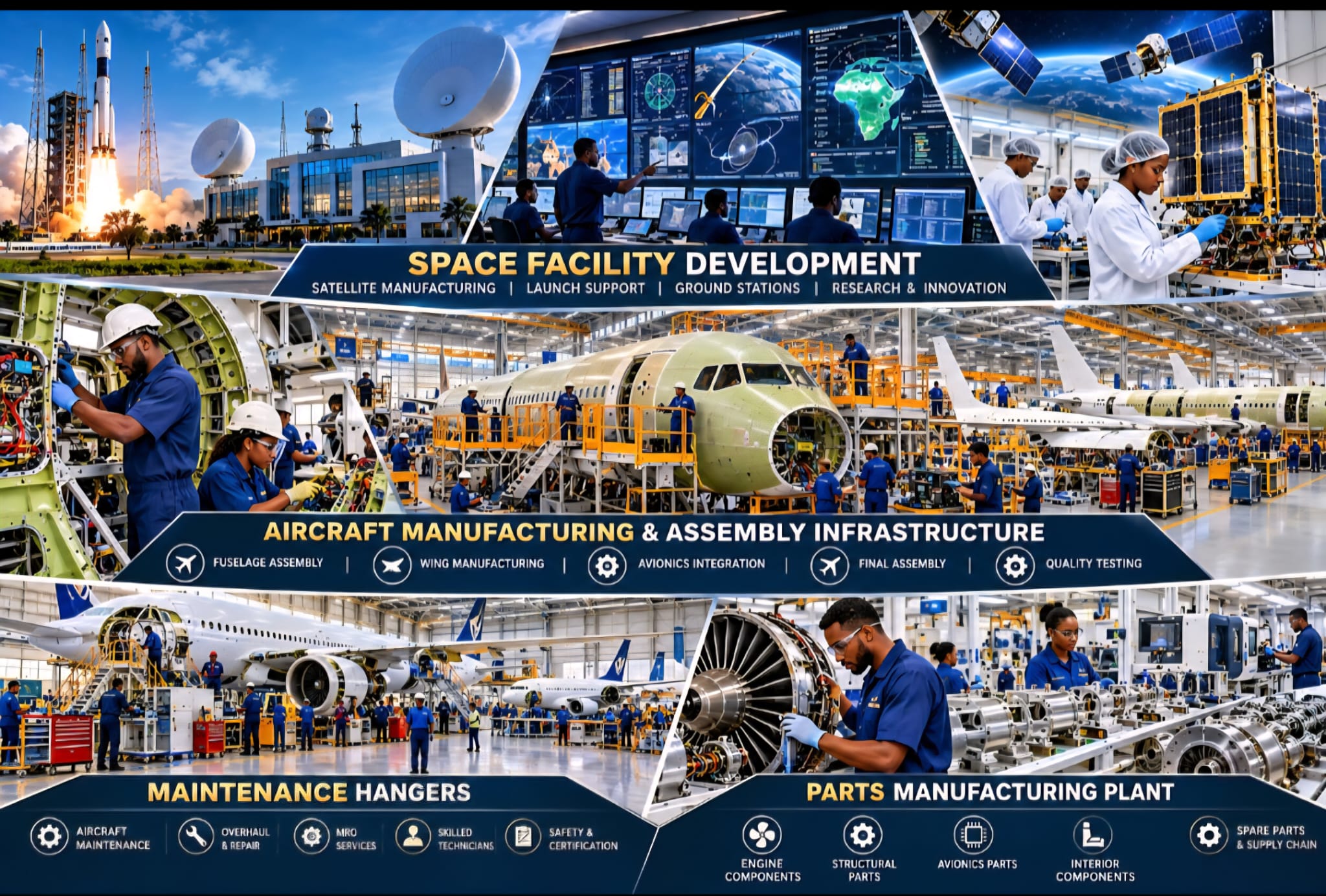
The initiative aims to establish a cohesive, end-to-end aerospace ecosystem that unites space facility development, aircraft manufacturing and final assembly, maintenance hangars, and parts manufacturing.
Benefits include shortened supply chains, reduced lead times, increased domestic capability and security of supply, workforce development, job creation, and enhanced global competitiveness in aviation and space sectors.
A phased, risk-aware approach with strong governance, public-private partnerships, and advanced digitalization is essential to deliver sustainable, high-quality facilities and operations.
Vision and scope
Vision: Create an internationally competitive aerospace hub that enables rapid design-to-deployment cycles across space systems and aircraft, supports ongoing maintenance and overhaul, and locally produces key components and parts.
Scope:
Space facility development: payload integration and testing, spacecraft assembly and integration, ground support infrastructure, mission control and range operations, and launch/processing capabilities where applicable.
Aircraft manufacturing and assembly infrastructure: subassembly facilities, final assembly lines (FAL), system integration, test cells, quality assurance, and flight-test support.
Maintenance hangars: large, flexible MRO bases for commercial and defense aircraft, spacecraft-related maintenance, components repair, and through-life support.
Parts manufacturing plant: machining, composites, additive manufacturing, propulsion components, avionics packaging, and build-to-print/ build-to-spec capabilities integrated with the supply chain.
Key components and facility typologies
Space facilities
- Payload integration and clean rooms with ISO-class controls.
- Spacecraft assembly, integration, and test (AIT) facilities with vibration, thermal, and acoustic testing capabilities.
- Ground systems: telemetry, tracking, data handling, mission control centers, and cyber-secure data networks.
- Launch and range infrastructure (if applicable): fueling, safety zones, logistics, and regulatory compliance.
Aircraft manufacturing and assembly
- Subassembly plants (fuselage, wings, tail, propulsion interfaces) connected to a central FAL.
- Final assembly line with integrated systems testing, flight-line readiness, and certification support.
- Advanced manufacturing cells: robotics, automated materials handling, quality labs, and digital twin-enabled processes.
Maintenance hangars
- Heavy maintenance bases with scalable hangar bays, tooling, and logistics hubs.
- Predictive maintenance engineering and support facilities.
- Component repair, overhaul, and exchange programs, with integrated supply and repair networks.
Parts manufacturing
- Machining and casting/forging shops, composites layup facilities, additive manufacturing (3D printing), heat-treat and surface finishing.
- Electronics and avionics assembly lines, cable harness manufacturing, and propulsions components fabrication.
- Quality, test, and traceability labs with robust ERP/MES integration.
Site planning, siting, and infrastructure
Location strategy
- Proximity to major airports, seaports, and rail corridors for efficient logistics; access to skilled labor pools and universities.
- Appropriate airspace coordination and regulatory alignment for both aircraft and space operations.
Utilities and infrastructure
- Reliable power with redundancy, including options for on-site generation and renewables; robust water and wastewater systems; climate-controlled environments for clean rooms and labs.
- High-capacity data networks, cybersecurity-ready IT infrastructure, and digital twin/PLM/MES platforms for end-to-end visibility.
Environmental and sustainability
- Energy efficiency targets (low-temperature waste heat recovery, LED lighting, insulation), low-emission transport links, and responsible waste management.
- Environmental impact assessments and ongoing monitoring to meet local and international standards.
Urban and industrial integration
- Compatible land-use planning, industrial zoning, and logistics hubs that minimize disruption to surrounding communities.
- Workforce housing, education partnerships, and community engagement programs.
Technology, digitalization, and operations
Digital backbone
- Integrated PLM, ERP, MES, and digital twins to synchronize design, manufacturing, assembly, and maintenance.
- Real-time supply chain visibility, AI-driven quality control, and predictive maintenance analytics.
Advanced manufacturing
- Robotics and automation for repetitive or hazardous tasks; additive manufacturing for rapid prototyping and spare parts.
- Flexible manufacturing lines to accommodate multiple programs and variants.
Security and compliance
- ITAR/EAR-compliant governance for space and defense-related activities; cyber resilience, access controls, and secure data exchange.
- Robust safety management systems, incident reporting, and continuous improvement loops.
R&D and innovation
- Proximity to universities and national labs to foster co-development in propulsion, materials science, autonomous systems, and green aviation technologies.
- Workforce, partnerships, and governance
Talent pipeline
- Training centers, apprenticeship programs, and aligned degree pathways with local universities and technical institutes.
- Upskilling programs for digital manufacturing, robotics, and space systems engineering.
Partnerships
- Public-private partnerships (PPPs), government space/aviation agencies, major OEMs, suppliers, and international collaborators.
- Supplier development programs to ensure local content, quality, and resilience.
Governance and regulatory framework
- A dedicated governing body or joint venture structure with clear roles for government, industry, and academia.
- Transparent procurement, performance-based contracts, and risk-sharing mechanisms.
Financing, economics, and risk management
Funding model
- A mix of public funding for foundational infrastructure and PPPs for facilities and operations, with incentives for private investment, export-oriented programs, and regional development grants.
- Phased financing aligned with milestone-based deliverables to manage risk and ensure accountability.
Economic rationale
Expected multipliers in GDP, job creation, and exports; improved supply chain resiliency; and strategic national capability in space and aviation.
Risk management
- Strategic risk assessments for regulatory changes, supply chain disruptions, technology obsolescence, and geopolitical factors.
- Insurance, contingency planning, and modular, scalable facility design to adapt to changing requirements.
Implementation roadmap (phased)
- Phase 1: Strategic study and site selection
- Market analysis, regulatory alignment, and stakeholder engagement.
- Preliminary facility concepts, risk register, and high-level financial model.
- Phase 2: Foundational infrastructure
- Land development, utility upgrades, road/rail access, and basic buildings for administration, R&D, and training.
- Establish core digital backbone and regulatory compliance framework.
- Phase 3: Core manufacturing and space facilities
- Construction of space AIT/clean rooms, aircraft FAL, and primary hangars.
- Initiation of parts manufacturing pilot lines and lightweight materials development.
- Phase 4: Scale-up and integration
- Full-scale manufacturing, assembly, and MRO operations; integration of supply chain, avionics, and propulsion components.
- Space facility readiness, mission control capabilities, and testing ranges (where applicable).
- Phase 5: Maturity, optimization, and expansion
- Capacity expansion, program diversification, and continuous improvement programs.
- Export programs, international collaboration, and potential diversification into adjacent aerospace domains.
KPIs and performance metrics
- Throughput and cycle times for each facility category (space, aircraft, hangar, components).
- Asset utilization rates, downtime, and on-time delivery metrics.
- Quality indicators: defect rates, rework, end-to-end traceability, and certification cycles.
- Workforce metrics: headcount, retention, training hours, and skills development.
- Safety, environmental, and regulatory compliance scores.
- Economic indicators: job creation, regional GDP contribution, and export volumes.
Potential outcomes and impact
- End-to-end domestic capability spanning design, manufacturing, assembly, testing, and maintenance for space and aviation programs.
- Strengthened national resilience through diversified and localized supply chains.
- High-skill job creation and a platform for advanced manufacturing and space tech entrepreneurship.
- Enhanced global competitiveness and export potential for both space systems and aircraft platforms.
Conclusion
An integrated aerospace infrastructure development initiative that combines space facility development, aircraft manufacturing and assembly infrastructure, maintenance hangars, and a parts manufacturing plant can deliver a resilient, globally competitive aerospace ecosystem. Success hinges on clear governance, phased implementation, robust digitalization, strong industry partnerships, and a committed focus on workforce development and sustainability. If you’d like, I can tailor this write-up to a specific region or provide a detailed programmatic plan with a rough cost estimate and implementation timeline.
Featured Projects
African Infrastructure Investment Ltd. is committed to advancing the aviation sector across the African continent through strategic aerospace infrastructure and industrial development. The company’s featured projects focus on building a sustainable aviation ecosystem that supports aircraft production, maintenance services, and component manufacturing to strengthen Africa’s growing aviation industry.
Aircraft Parts Manufacturing Plants
The company is developing specialized aircraft parts manufacturing plants to produce essential aerospace components such as structural assemblies, precision machined parts, composite materials, and avionics support structures. These facilities will support both commercial and government aviation fleets while reducing reliance on imported components and promoting local industrial capacity.
Maintenance, Repair and Overhaul (MRO) & Hangar Facilities
African Infrastructure Investment Ltd. is also establishing modern aircraft maintenance and hangar facilities designed to provide comprehensive Maintenance, Repair, and Overhaul (MRO) services. These facilities will service commercial airlines, cargo operators, and government aviation fleets across Africa. Equipped with advanced diagnostic and engineering capabilities, the centers will enhance operational efficiency, safety compliance, and aircraft lifecycle management within the region.
Aircraft Manufacturing & Assembly Lines
To further strengthen the aviation industry, the company is developing aircraft manufacturing and final assembly line facilities within Africa. These projects will support the assembly of light aircraft, regional transport aircraft, and specialized aviation platforms. The initiative will encourage technology transfer, workforce development, and regional industrial growth while positioning Africa as an emerging hub for aerospace manufacturing.
Through these integrated projects, African Infrastructure Investment Ltd. aims to support the long term growth of the aviation sector in Africa by providing critical infrastructure, enhancing technical capacity, and promoting economic development across the continent